
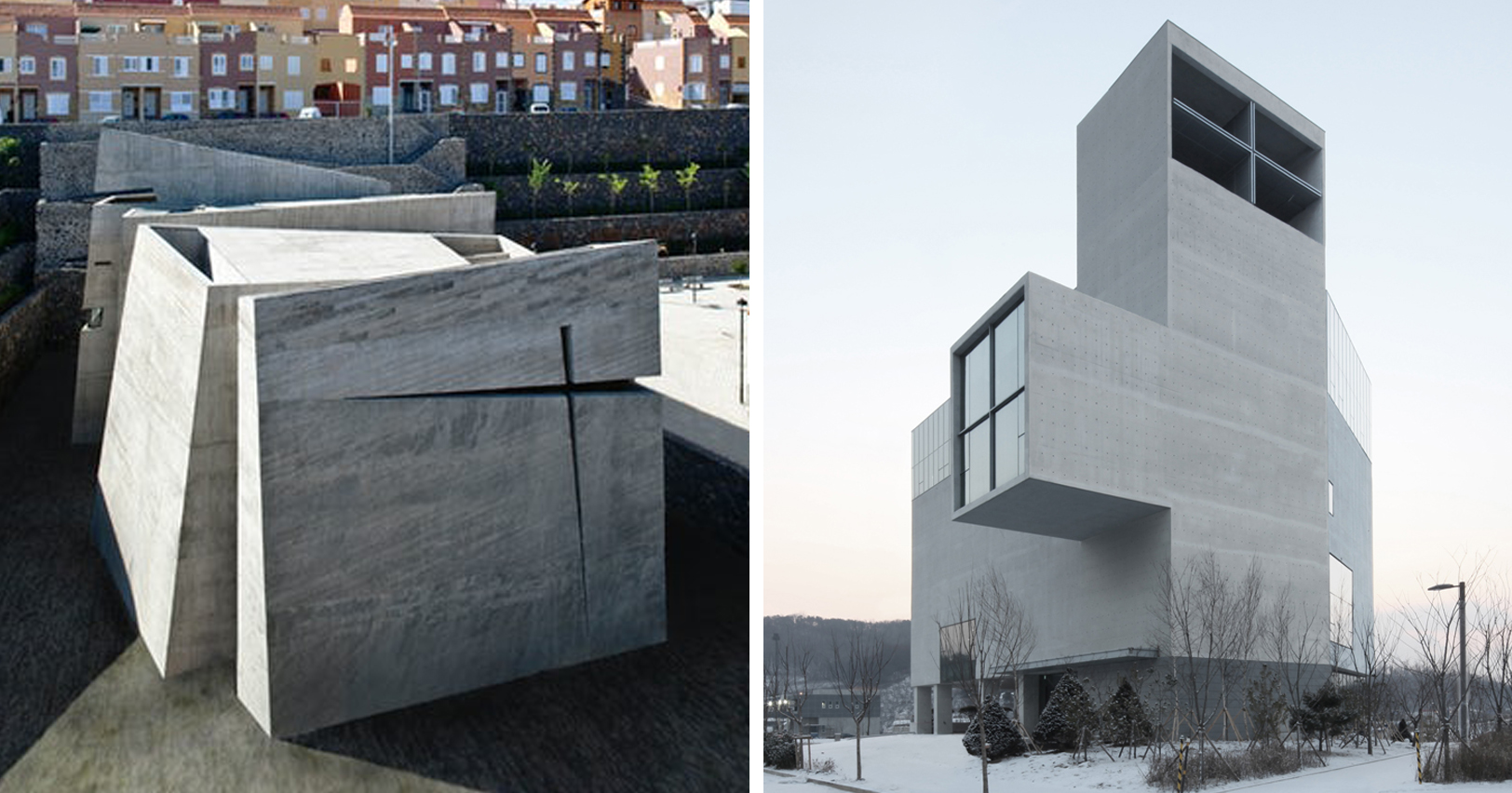
By concrete Catholicism I am NOT referring to the sort of Catholic Church in the illustration. Instead I’m writing about the solidity of our Catholic faith. I can best explain what I mean by comparing Catholicism to other forms of religion.
Most other forms of religion in our day deal with personal, subjective emotions or personal opinions or individual theologies and ideologies. The Protestant evangelical bases his religion, for example, on the personal experience of “getting saved”. This usually entails a powerful personal and emotional experience. While that sort of thing may be helpful, it remains a personal, subjective and illusive criteria. There’s everything emotional about it but not much that is solid and objective.
The Protestant Evangelical will reply, “This is based on the Scriptures. ‘Believe in the name of the Lord Jesus Christ and you will be saved!” Yes, but “belief in the Lord Jesus Christ” remains insubstantial and ephemeral. Mormons believe in Jesus Christ. Moonies believe in Jesus Christ. Snake handling fundamentalists believe in Jesus Christ. So do liberal Protestants. What that belief means and consists of remains elusive, subjective and open to almost any interpretation.
A more dogmatic Protestant will argue that his beliefs have to be Bible based, but that simply pushes the problem back one notch. Which Bible? Who interprets it? How do you know they have the authority to interpret and not some other preacher or theologian? Islam and Judaism—which are also religions of the book—have the same problem: which version and which interpreters of the texts shall we use?
Other religions are worse. Eastern religions are based on a collection of myths or a system of meditation to produce personal illumination. Same with New Age religions.
The concreteness of Catholicism, on the other hand, is always impressed upon me when I am hearing confessions. Here my ordinary parishioners come to God in an objective sacrament. They kneel and confess particular things they have done wrong or things they have left undone. Its real. Its particular. It’s down to earth. Its concrete.
Then I give them a penance. They make an act of contrition and I grant absolution. Again. It is a particular action done at a particular place in a moment of time. A person kneels. The sins are confessed. The prayers are said and the absolution is given. I assure them that the forgiveness granted is a real, sacramental objective and unconditional fact. It does not rely on his pious I feel in the confessional nor on the emotion (or not) that they feel in the confessional.
The act is a fact. It is concrete Catholicism in action, and of course, it is all based in the concrete particularity of the incarnation. The Son of God came to earth and took human flesh of his Blessed Mother at a particular place in the world and in a particular moment of human history. It was not an idea or a myth or a political ideology. It did not depend on a moment of emotion—either of fear or joy, but on an action of divinity in the reality of our world.
Same thing with the concreteness of our faith. It is something real. Solid and everlasting. So one of my theological heroes, St John Henry Newman wrote: “Christianity is not a mere idea, but a fact; not an abstraction, but a living reality; not a system of thought, but a life and a power.”



Leave A Comment
You must be logged in to post a comment.