
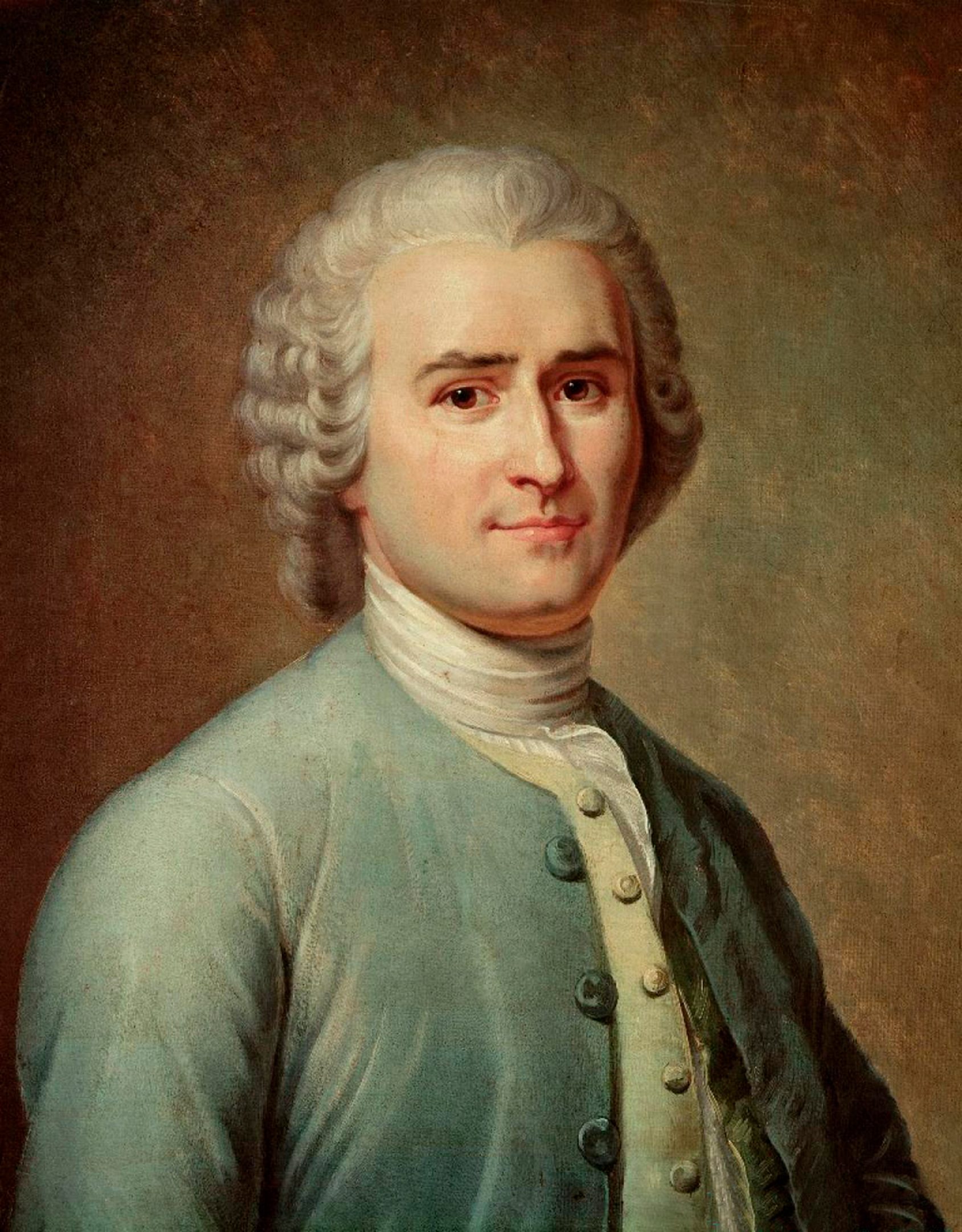
Of all the stars in the enlightenment constellation, Jean Jacques Rousseau is one of the most attractive. Born into a Protestant home in Geneva, his mother died within ten days after his birth. When his father fled to avoid imprisonment, Jean-Jacques went to live with an uncle and was apprenticed to an engraver. The strict Protestant culture and context instilled in the youth a dislike of authoritarian structure and societal strictures.
At the age of sixteen he ran away and was taken in by Madame de Warens, a Catholic convert who became his benefactor, lover, and maternal figure. Under her influence, he briefly converted to Catholicism, abandoning his Protestant upbringing. Rousseau worked various jobs—tutor, music teacher, and copyist—while traveling through Switzerland, France, and Italy. His early years were marked by poverty, instability, and a sense of alienation, which consolidated his dislike of authority and fueled his harsh critiques of society and its pressures.
Rousseau’s life was filled with controversy, personal passion, and immorality. A long running relationship with his common law wife Therese was interspersed with numerous illicit affairs, and most scandalously, he convinced Therese to abandon their five children to orphanages claiming that he could not support them. This did not limit him from writing a treatise on childhood education however.
Not surprisingly, Rousseau’s personal life—one of wild abandon and eventual shipwreck influenced his writings. He was a champion of the individual spirit over established, traditional authorities. Paradoxically, in his political writings he also called for the individual to make sacrifices for the common good. His novel Julie was a sensation across Europe. In it he championed the woman who could be liberated to fulfill her erotic desires free from societal and religious constraints.
As a star of the free thinkers Rousseau is also a forerunner of romanticism. While the enlightenment thinkers famously exalt human reason over divine revelation, Rousseau took the logical next step and moved on from the supremacy of human reason to the supremacy of human emotion, and thus opened the gates to full blown Romanticism which would in turn open the floodgates to the individualism and modern subjective relativism which is the dictatorship of our day.
My task in this column is to connect the Inklings to our esteemed editor’s theme, and I have chosen Rousseau among the enlightenment luminaries because, while C.S.Lewis did not write very much specifically about Rousseau, he had plenty to say about the consequences of Rousseau’s distorted ideas and decadent life.
There are four aspects of Rousseau’s thought that Lewis critiqued. The first is the idea of the noble savage. Rousseau wanted to uphold mankind’s essential innocence—an innocence and nobility spoiled not by original sin, but by the corruption and domination of society’s senseless rules and regulations. In The Problem of Pain and Mere Christianity Lewis insists that evil is intrinsic to human nature because of original sin. He sees man’s essential innocence in Rousseau’s thought as unrealistic sentimentality which will ultimately lead to the hubris and ignoble savagery displayed by the atheistic scientist Weston in Perelandra and the sinister optimism of the denizens of N.I.C.E in That Hideous Strength. Their belief in the essential goodness of man blinded them to their own violent tyranny.
In Emile, Rousseau campaigned for a new approach to childhood education which was inspired by the child’s natural goodness and innocence. His theory encouraged education by natural experience and reliance on the child’s natural curiosity, instincts, emotions and urges. In The Abolition of Man Lewis explodes the idea that values are based only in what a student “feels” about a particular fact, and instead argues for education based in objective facts and values based in the Tao—Lewis’ term for an overarching system of moral values recognized and shared universally.
While Lewis had a lot of time for the Romantic poets he was also careful to criticize subjective emotion as the only criteria for discerning truth. Tracing the romantic’s reliance on personal emotion back to Rousseau, in The Allegory of Love he criticized subjective emotionalism as the sole authority.
Finally, when it comes to Rousseau’s political theory, Lewis stands as a stark critic. In The Social Contract, Rousseau proposed that legitimate governance rests on the “general will,” where citizens collectively surrender individual rights for the common good, ideally through direct democracy. Lewis was skeptical of utopian political theories that assumed human systems could perfect society. In That Hideous Strength (1945), he critiqued ideologies that prioritize collective ideals over individual dignity.
Despite the conventional Christian critique of the enlightenment thinkers, it must be accepted that they refreshed many truths that lie at the heart of Augustinian Christianity. The dignity and goodness of each person created in God’s image, the need for the individual to contribute to the greater good, the goodness of mankind’s quest for beauty and bliss, and the human heart’s yearning for love are all part of traditional, historic Christian theology.
Rousseau’s thought, like his life, was distorted and out of balance. Lewis balances the boat by setting the correct priority in these four areas: Humans are intrinsically good, but the image of God in man is wounded by original sin and needs healing. Children should be educated through their natural curiosity and desire to please, but that desire needs to be carefully trained by the hard edge of objective truth. Subjective emotions and desire are good for they are essentially the desire for what is beautiful, good and true, but those emotions and desires need to be verified by objective truth and disciplined by a divinely appointed authority. Finally, it is noble for the individual to make sacrifices for the common good, but what constitutes the common good cannot claim priority over the individual and his rightly formed conscience.
Lewis’ critiques of Rousseau reveal the heart of the disagreement. While Rousseau unlocked some beautiful truths, he missed the priority of truth. “The first commandment is to love God and the second is like—namely this—to love one’s neighbor as oneself.” If Rousseau had built on this foundation his philosophy would be more convincing.
Rousseau was passionate about secondary issues and neglected the first concern. This is the error of all heresy—not that it is totally wrong, but that it is only partially right.
Fr Longenecker’s book Beheading Hydra- A Radical Plan for Christians in an Atheistic Age explores these themes further. Find it at dwightlongenecker.com
Leave A Comment
You must be logged in to post a comment.