
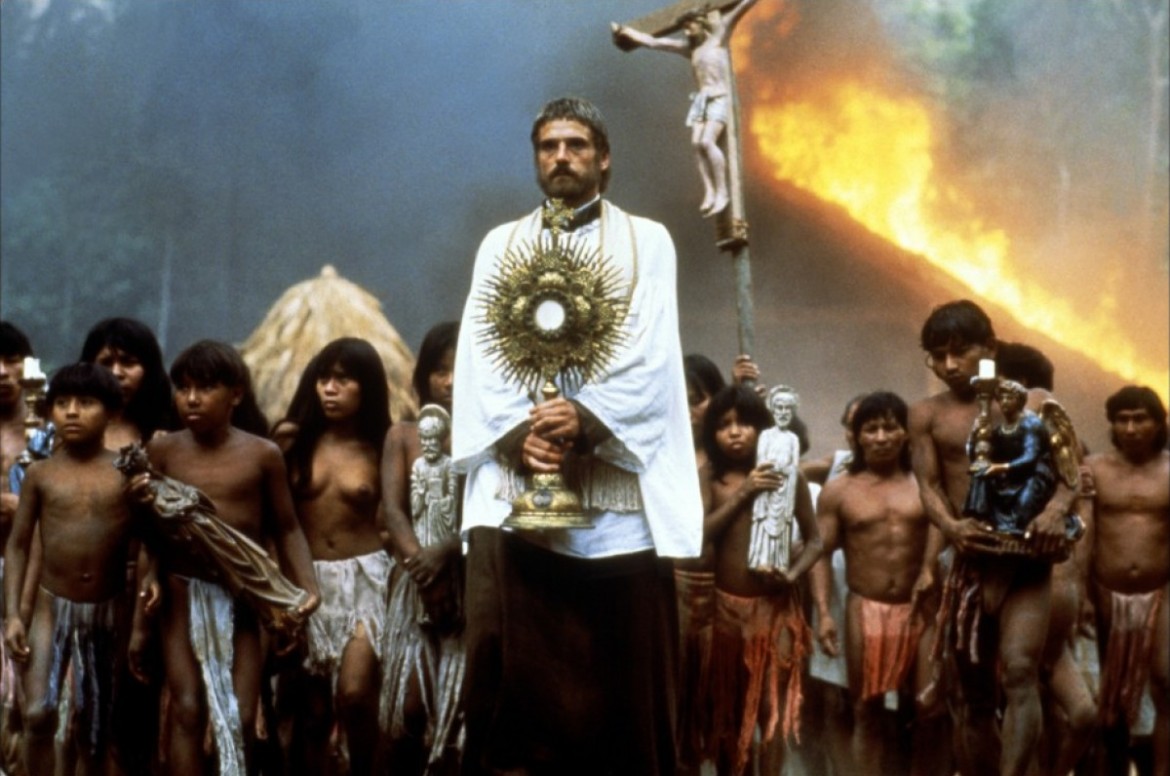
We were talking movies and my friend Rick told the story of watching the fantastic movie, The Mission with a group of parishioners in a progressive parish in some city up North.
They had a discussion about the film afterwards and Rick said, “I just found it amazing the lengths the missionaries would go to bring the gospel to the natives.”
He was surprised when one of his fellow Catholics was shocked. “Did we actually watch the same movie?” He asked. The progressive Catholic was not impressed by the missionary effort. He was disgusted and dismayed. First, the people were “indigenous people” they weren’t “natives”. Second, he thought it deplorable that the white male, European missionaries had invaded the territory of the indigenous people forcing them to convert to Christianity.
You get it.
What is a core principle of the Christian faith — bringing the gospel to those still untouched by the good news of Christ–was considered bad form, colonialist oppression, imperialist arrogance and white privilege.
The story illustrates the total division between the two different Catholic Churches.. One group of Catholics may be called “historic Christians” the other “secularists or progressives.” The historic Christians simply believe the old, old story of a lost humanity in need of savior. They believe that Jesus died to save us from our sins and that all people should come to know the gospel so that they might move out of darkness into his marvelous light.”
The other “Catholics”? What do they believe? In my experience they believe the same thing all the other progressive worldlings believe. They believe the secular gospel of a human race that is always getting better by its own efforts. They believe in total individual freedom without any restraints. They believe in the Christian faith is the best way to make the world a better place, work for peace and justice and help the poor. They believe in women’s rights to abortion and homosexual rights to be married.
In other words, what they believe is indistinguishable from what all other secular, humanist Americans believe. The only difference is that they “identify” as Catholics, and furthermore, they believe their agenda is also the real agenda of the Catholic religion.
What is the root of this division? It is a basic philosophical disagreement. The secular humanists believe the Christian faith is a human creation. It was forged in a particular cultural milieu and out of particular historical conditions. Because of this, it should not only adapt to the culture in which it finds itself, it MUST adapt to the culture in which it finds itself. In this viewpoint the historic Catholic faith is always wrong. The prevailing culture (whether the primitive people of New Guinea or the primitive people of New York) must be superior and must “correct” historic Catholicism.
The historic Christians believe precisely the opposite. We believe Christianity was revealed by God to the human race by a direct divine inter action. “In the fullness of time God sent forth his son, born of a woman.” This historic gospel does not change with time or adapt to the culture in which it finds itself. Certainly the mode of expression and the method of communication may change, but the core gospel does not change. It challenges and corrects the world. The world does not challenge or correct it.
This is the essence of the Christian faith, and what I don’t get. What I really, really don’t get is that these secular, progressive Catholics are the ones who call us historic Christians “hypocrites.” Do we fail in realizing all our spiritual goals and ambitions? Sure. Do we talk the talk but not walk the walk? Of course. It goes without saying.
The division, therefore, in the Catholic church is very deep indeed. It goes right to the roots. At present we patch things up. We pretend there is unity. We avoid talking about these issues because we sense that they are unresolvable.
Indeed they are. A friend of mine in the Anglican church put it this way after trying to dialogue with a secular, progressive Christian. He said, “It was like we were playing tennis on two adjacent courts.”
Historic Christians should stop and realize that this is the real divide. I was talking yesterday with a young Catholic guy who is intent on helping to make the celebration of Mass more reverent. I’m on his side and I want to help. However, our conversation soon turned to basic questions. I was critical of the idea that simply by tinkering with the externals we will “make the Mass more reverent”. I don’t know how many people I’ve listened to who seem to believe that “if only we brought back altar rails and everyone received communion on the tongue then that would fix things in the church.” The externals might improve the perception somewhat, but it would be a Band-Aid on cancer.
The problem, as I outlined above, is far more basic, and it is also not simply a problem with “poor catechesis” Yes, that is a problem, but to be brutally honest the profound divisions in the church are present not only among the laity who have been poorly catechized, but also among the clergy and hierarchy. This basic misunderstanding of what the gospel is about and therefore what the church is for and what the Eucharist is and does goes right to the top. The dis-satisfaction among many historic Christians with Pope Francis was not about politics or liturgy or personalities, but the fact that he was a progressive Catholic who clearly had disdain for historic Catholicism.
So, it is not simply between liturgical, political or disciplinary disagreements. This is not between those who like the traditional Mass or those who like the Novus Ordo. This is not between political opinions or matters of taste. This is not about Vatican II or pre Vatican II. This is not about whether you home school or not or whether women should wear chapel veils. It is not about “this Catholic college is better than that Catholic college.”
It is not about any of that.
It is about this deep, deep divide. A divide that cannot be breached. It is a divide between sheep and goats, and between weeds and wheat, and from where I am I can see only that this cannot be resolved here and now.
I don’t know how it can be mended. When the clergy get together or there is a big Catholic event we all pretend we follow the same religion, but the truth is our philosophical and theological starting points are so opposed that, like I said above, “its like we are trying to play tennis on adjacent courts.”
Perhaps it can only be resolved on that day when the Great Judge separates the sheep from the goats and takes the weeds, gathers them up and throws the on the fire.



Yes, the division is very deep. Consider this:
Matthew 12:25: And Jesus knowing their thoughts, said to them: Every kingdom divided against itself shall be made desolate: and every city or house divided against itself shall not stand.
And this: “A house divided against itself cannot stand. … I do not expect the house to fall — but I do expect it will cease to be divided. It will become all one thing or all the other.” Abraham Lincoln, 1858.
Christ also talked about this divide in Matthew 10 and Luke 12. And Christ also commanded His Apostles to go and teach and IF they accept you, stay awhile; if not, walk away.
I think we all have those in our lives who reject our understanding of our proper relationship with Christ. But are we really suppose to bring it up only once with each person? Guarding against being a true persistent pain in the posterior, perhaps at another time, when we both have more experience, we can share thoughts that helps the other pull back from the path leading to the fire?
Also brings to mind why Progressive Catholics don’t traipse up the street and join the Episcopalians. Answer because in their own words, “because we wouldn’t have anything to protest, change or correct.” But getting back to the offended at the viewing of “Missions”, the indigenous do get their revenge or at least that’s what Progressive Methodists claim in the recent vote on gay marriage and Gay Clergy. Oh those patronizing Progressive Methodists who now mutter about letting Africans and Polynesians vote in the first place first, “we should have known what would happen when you let our 3rd World fellow Christians grab the rudder”. Soon after the vote against gay marriage many, no hundreds, or most of the United States and Canadian Methodist Churches shuttered their doors just as the Media predicted, didn’t they?
That’s what prayer, penance, and sacrifice are for, to show the truth of Jesus and let Him use us to bring them to Him.
Thanks for the excellent description of the Christian division today. You should know that I dropped out of the Lay formation because of the divided thinking in our diocese. This was about 15 years ago and I’m glad I did. I know the Catholic Church has the correct teachings but wading through the swamp of heresies was more than this old retired Navy Chief could tolerate.