There are some Catholic liturgical purists who reject the use of hymns in the liturgy. I understand their argument. The liturgy stand alone without the need of extra hymns. The psalms, chant, antiphons etc are full and adequate. Then there is the other point that some traditionalist make with their noses in their…”Hymns are Protestant!” they sniff.
Never mind that in the very limited instructions on Christian worship in the New Testament St. Paul himself writes, ”
Let the word of Christ dwell in you richly in all wisdom; teaching and admonishing one another in psalms and hymns and spiritual songs, singing with grace in your hearts to the Lord. (Col. 3:16) and “Speak to yourselves in psalms and hymns and spiritual songs, singing and making melody in your heart to the Lord;” (Eph. 5:19)
But I suppose for the extreme traditionalist Catholic quoting Scripture is also “Protestant”. Excuse me
Now, I’m the first to admit that the vast majority of hymns written after the Second Vatican Council are terrible. Many of them (like Make Me a Channel of Your Peace) were written for a soloist–with a geetar. As folk songs sung by a hippie soloist they have their place. (You may decide what that place is) but they were not written to be sung by a congregation. Much of the rest is poor poetry of maudlin sentiment added to music inspired by soft rock, Broadway musicals or Cole Porter. Think the Carpenters singing about Jeezus. Yuck.
However, there is a wonderful repertoire of hymns from the Anglican/Methodist tradition–hymns written before the descent into modernist heresy of those denominations. The great hymns from that repertoire contain great poetry, sound theology and are usually sung to splendid tunes that are written for congregational singing and which support the words perfectly.
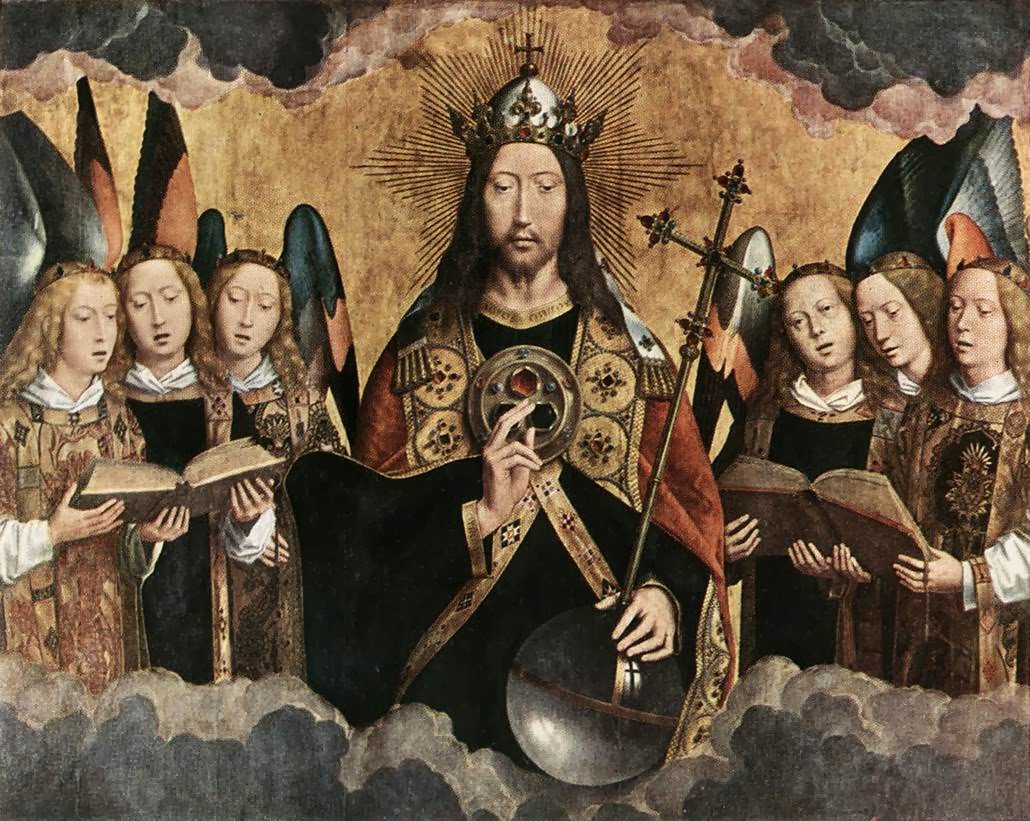
A good example is one used for today’s Solemnity of Jesus Christ King of the Universe.
Crown him with Many Crowns was written by Matthew Bridges (d. 1894) an Anglican who later converted to Catholicism. His hymn originally had six stanzas drawing on imagery from the Book of Revelation–and it was Catholic in its imagery. So, for instance, this is the original second stanza:
Crown Him the Virgin’s Son,
The God Incarnate born,
Whose arm those crimson trophies won
Which now His brow adorn!
Fruit of the mystic Rose,
As of that Rose the Stem;
The Root whence mercy ever flows,
The Babe of Bethlehem!
A bit later an Anglican clergyman Geoffrey Thring considered Bridges work “too papistical” and cut the second and sixth stanzas. (The “papistical” content in the sixth stanza referred to kings and priest and martyrs) Thring’s revision brought this “papistical” hymn into the Anglican and Protestant mainstream and it is now universally beloved.
Bridges’ deeply scriptural and beautiful text is combined with a tune written by George Elvey especially for the words. The name of the tune is Diademdata (means crowns in Greek) is suitably majestic. Stop for a moment and sing that opening phrase “Crown Him With Many Crowns” and imagine it as a royal trumpet fanfare. Perfect!
Good hymns properly used in the liturgy help to catechize the people, inspire them and lift their hearts in song–remembering the words of St Augustine that “he who sings prays twice.” Furthermore, something happens when you sing: not only does your mouth open. Your heart opens too. It is impossible to sing without letting down your guard and opening your heart and yielding to the music. This, by the way, is the real reason why so many Catholics stand in Mass with their arms crossed and mouths closed. They don’t want to sing because they resist (even subconsciously) the vulnerability that comes with singing.
Take a moment now if you will to listen to
this perfect performance of this practically perfect hymn by Kings’ College Choir, Cambridge. (Sorry Catholic purists, but they’re Anglican) On a personal note, this recording was made while I was a chaplain at Kings’ College, Cambridge. The beauty and majesty of it is stunning and I have to admit my eyes were leaking.
Enjoy.





What a coincidence (or grace?)! We sang this hymn at the end of our Mass today (a TLM, BTW) at St. Mary’s in Kalamazoo. I particularly enjoyed this striking second verse. I didn’t recall seeing it before, although I’ve loved this hymn for years–a real rouser. Our organist had to make new handouts, and I guess she found the right version. She also plans to use the new Marian hymn which you recently generously shared.