
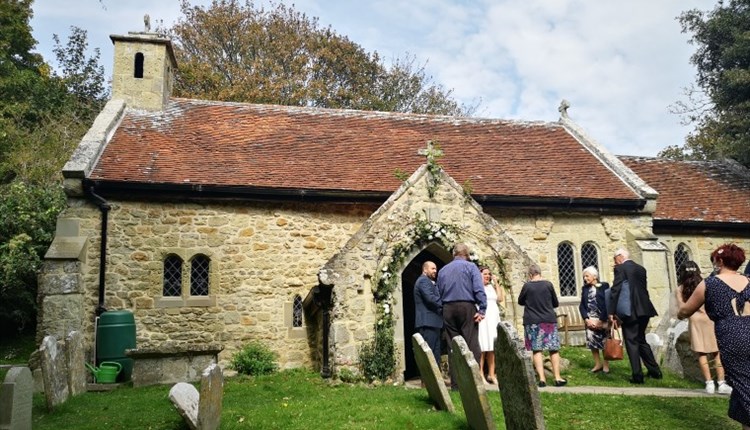
When I was a priest in the Church of England I served as the Vicar of Brading on the Isle of Wight. A favorite part of the island was St Boniface Down–a lovely hillside overlooking the sea where breezy hikes and picnic spots were abundant. It stood above St Boniface parish–where a suitable Neo-gothic church was nestled in a snug little dingle. Next to the church was a huge Victorian vicarage house. It was just the sort of parish I would have applied for if I had stayed in the CofE. Especially nice was the fact that a winding footpath and narrow switchback road led down through the woodland to a tiny church right on the shore. This was “the old St Boniface”–pictured above–
St Boniface was an English monk and Bible scholar born at the end of the 7th century in Crediton in Devon. He famously visited and preached on the Isle of Wight–which was still partially pagan and this fits with similar tales of his contemporary St Wilfrid who came ashore in what was my parish of Brading and erected a wooden church (as the legend goes) on the site of St Mary’s Brading (of which I was vicar)
Boniface went from the Isle of Wight to preach to the pagan tribes of Northern Europe, converted many, helped to reform the monasteries and established strong links with the pope and the king. In his 70s he moved West to preach in what is now the Netherlands where he and his followers were martyred.
Last summer, on a tour of England with my brother Don we found ourselves in Devon on a Sunday morning. Snooping around for a Catholic Church we discovered a modern, cheaply built hall in the town of Crediton (Boniface’s birthplace) dedicated to St Boniface. A reminder, if I needed one, of the continuity and living memory of the Catholic Church. It was a brutal, modern building with a Mass and music that couldn’t be said to be inspiring except for the fact that in that town where the saint was born the Catholic Mass is still there, and this poor priest, in a church in South Carolina nineteen centuries later wore red and asked the altar servers what they knew about the saint of the day and they were on it: that he was English, that he was born in the seventh century, that he was a missionary to the Germans. Proudofem.
Finally, I’m reminded that, as a young man I too told the Lord I would be a missionary. I prayed, “Lord, send me to the darkest, place where the cruel and barbaric natives are locked in their wicked depravity, who had God and love their sin, who reject the gospel and love their decadent ways…”
…so he sent me to England.



Leave A Comment
You must be logged in to post a comment.