
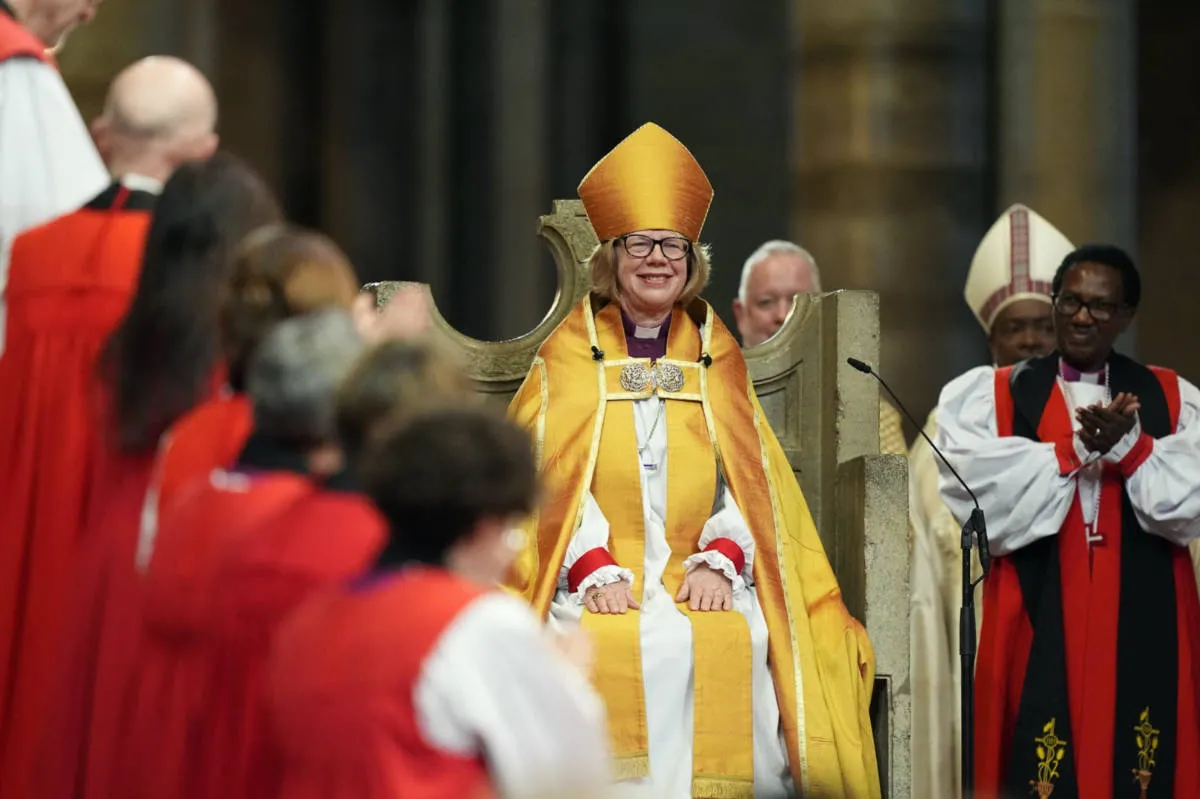
In the wake of the controversial enthronement of Sarah Mullally as the first female Archbishop of Canterbury, conservative Catholics on social media bubbled over with indignation. When Pope Leo sent a letter of congratulations the grumblings and rumblings grew louder. The pope was “affirming heresy”! The pope was condoning women’s ordination! He should have corrected her, called her out as a heretic, scolded, reprimanded, issued a condemnation reminding her that Anglican orders were null and void!
Yes, all of that has been said from the Catholic side before and doesn’t really need repeating. Any Anglicans who are listening have already heard it and the others are so ignorant and indifferent toward Catholicism that it doesn’t really matter. Those who are listening and have heard the condemnations from Rome have disagreed and often not only disagreed vehemently, but offered considered and well supported rebuttals.
What Pope Leo did instead, was use the Pope’s regular Wednesday catechesis to address the underlying question. I recommend that you take the time to read the pope’s teaching. It’s not long, and it is very clear and accessible. As usual with papal teaching it is full of references to church teaching, sacred Scripture, tradition and the teaching of his predecessors. You can read the whole thing here.
Some commentators have trumpeted headlines that in his catechesis the Pope was affirming male only priesthood. He only does so implicitly. Instead he gives a teaching about the Catholic understanding of the sacrament of Holy Orders. He has seen that the real issue with women’s ordination is not the sex of the person being ordained, but I disagreement (or lack of understanding) about the nature of the priesthood itself. This is where the real disagreement lies, and the Holy Father is pretty smart to address this matter rather than the issue of whether women can be ordained or not.
Here’s the thing: a Protestant minister is a minister. A Catholic priest is a priest in apostolic succession exercising the authority handed on to him from Christ himself. To make my point, I find it very interesting that Mrs Mullally’s first vocation was as a nurse. As such she exercised a ministry of caring and concern for sick people. She also rose in the profession to be the UKs Chief Nursing Officer. Therefore she must also have had considerable leadership, communication and administrative capabilities. Good for her. It provided a strong resume for her present position. All of this echoes the career path of her predecessor. Justin Welby was a business executive before switching over to be ordained as a second career. The selection of Welby and Mullaly confirms the notion that the Anglican priest is essentially a minister.In other words, the approach to the job is utilitarian. The Christian minister in this view is a person who helps others. He or she is a kind person, a do gooder, someone on a mission perhaps to change the world, to bring justice and work for peace.
Now all of this is all well and good, and it is certainly something Christian ministers (including Catholic priests) should do, but that is not what a Catholic pries IS. The Protestant minister may very well be a religious social worker, an activist who prays, an executive with spirituality or a nurse who sees her work as Christian love in action. Fine.
But a Catholic priest is something else. When I was ordained deacon I had been working as a lay chaplain at a Catholic high school. When I returned to school the next day after my ordination to the diaconate a cheerful junior named Betsy said, “Mr Longenecker, do you feel ontologically different?” The girl had been well catechized. She knew that ordination imparts an indefectible character. The Catholic deacon, priest or bishop is therefore not defined by what he does, but by what he is. This is what Pope Leo sets out in his catechesis. He does not reprimand Mrs Mullaly or the Anglicans. He does not excommunicate, condemn and fulminate. He corrects misunderstandings by stating the truth. He lights a candle instead of cursing the dark.
To return to the question of women’s ordination…since the Protestant understanding of ordination is one of ministry rather than sacerdotal priesthood it follows that women’s ordination is perfectly acceptable. One of the arguments the advocates of women’s ordination made (and remember I lived through this in the 1980s in the Church of England) was that “Women can do the job just as well as men so why not?” This is obviously true so why deny it? But it is predicated on the assumption that being ordained is only about one’s ability to be a kindly minister, a worthy preacher, and able administrator and a capable leader.
As such we should be perfectly happy to congratulate Mrs Mullaly and all the other lady Protestant ministers. They are good church ladies. They can “do the job” and God bless them.
The confusion, therefore, is on their part. They have confused the worthy role of Christian minister with the historic Catholic priesthood. That they dress the part and say the words and play the role of a Catholic priest within their own tradition might be jarring–and even upsetting to Catholics, but it needn’t. Pope Leo’s catechesis about what a Catholic priest, deacon or bishop actually IS may help to clarify matters and contribute to the ongoing discussions between our churches.
We should also ask where this discussion fits historically. Obviously there are some Anglicans who would disagree with my characterization of the Anglican ministry as being no more than ecclesiastical social workers. The elevation of Welby and Mullally to the top job should, I think, make my point. However, some Anglo-Catholics will insist that Anglican priests really are priests in the Catholic sense and not just ministers. Again–the confusion is theirs. That is a debate that should continue within the Anglican Church. From my own experience having trained within the Evangelical wing of the Anglican Church I can testify that the Catholic understanding of ordination was firmly rejected. We were being trained as kindly ministers of the Word. Of course we were aware of the Anglo Catholic ordinands who had a higher opinion of priesthood, but well… they were just wrong.
At present the Anglo-Catholic wing of the Church of England is dwindling. The Evangelicals are in the ascendant and are blending into the classic liberal “broad church”mentality. Thus you get Welby and Mullally who are broadly and blandly Evangelical but really just broad and bland ministers. This, it seems to me, is a good thing for the Church of England because it brings clarity. Anglicans can now have a much more realistic understanding of who they really are and what their beliefs really are. They are a broad church with an essentially Protestant theology lodged in a grand historic tradition and draped in Catholic costumes and customs.
As discussions continue with Catholics this clarity will be essential, and Pope Leo’s Wednesday catechesis may help that vision and self understanding to come further into focus.



Leave A Comment
You must be logged in to post a comment.